Hoonah Alaska
Population:
851
Location and Climate
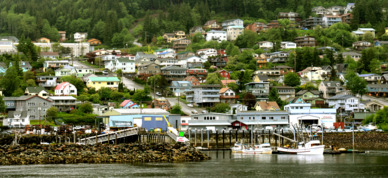
Hoonah is a Tlingit community located on the northeast shore of Chichagof Island,
40 air miles west of Juneau. It lies at approximately 58.11° North Latitude
and -135.44361° West Longitude. (Sec. 28, T043S, R061E, Copper River Meridian.)
Hoonah is located in the Sitka Recording District. The area encompasses 6.6
sq. miles of land and 2.1 sq. miles of water. Hoonah's maritime climate is characterized
by cool summers and mild winters. The airport is closed 20 to 30 days a year
due to poor weather; usually foggy periods in the spring and fall. Summer temperatures
average 52 to 63; winter temperatures average 26 to 39. Temperature extremes
have been recorded from -25 to 87. Precipitation averages 100 inches annually,
with 71 inches of snowfall.
History, Culture
and Demographics It is the principal village for the Huna, a Tlingit tribe which has occupied the Glacier Bay/Icy Strait area since prehistory. Local legend tells of an original ancestral home in Glacier Bay that was destroyed by a glacial advance. Hoonah means "village by the cliff." The Northwest Trading Co. built the first store in Hoonah in 1880. In 1881, the Presbyterian Home Mission and school was built. By 1887, 450 to 500 people were wintering in the village. A post office was established in 1901. In 1912, the Hoonah Packing Co. built a large cannery one mile north of town. The Thompson Fish Company still operates today as Hoonah Cold Storage. In 1944, a fire destroyed much of the City and many priceless Tlingit cultural objects. The federal government assisted in rebuilding the community. The City of Hoonah was incorporated in 1946.
A federally-recognized tribe is located in the community -- the Hoonah Indian Association. The population of the community consists of 69.4% Alaska Native or part Native. Hoonah is the largest Tlingit village in Alaska. Commercial fishing and logging have supported the population, and most residents maintain a subsistence lifestyle. During the 2000 U.S. Census, total housing units numbered 348, and vacant housing units numbered 48. Vacant housing units used only seasonally numbered 10. U.S. Census data for Year 2000 showed 317 residents as employed. The unemployment rate at that time was 20.55 percent, although 51.68 percent of all adults were not in the work force. The median household income was $39,028, per capita income was $16,097, and 16.57 percent of residents were living below the poverty level.
Facilities, Utilities,
Schools and Health Care
Water is derived from Shotter, Dalton and Spud Creeks, is treated, and piped
to all homes and facilities. A new water treatment facility was completed in
October 1998. Piped sewage is processed in a sewage treatment plant. 98% of
homes are fully plumbed. The City provides garbage collection services twice
weekly. The Tlingit-Haida Regional Electric Authority, a non-profit subdivision
of the State, operates three diesel-fueled generators in Hoonah. Electricity
is provided by City of Hoonah; Tlingit-Haida Regional Electrical Authority.
There are 2 schools located in the community, attended by 192 students. Local
hospitals or health clinics include Hoonah Medical Clinic (945-3235). The clinic
is a qualified Emergency Care Center. Hoonah is classified as an isolated town/Sub-Regional
Center, it is found in EMS Region 3A in the Southeast Region. Emergency Services
have limited highway, marine, floatplane, helicopter and air access. Emergency
service is provided by 911 Telephone Service, volunteers and a health aide.
Auxiliary health care is provided by Hoonah Volunteer EMS (945-3631/3655).
Economy and Transportation
Fishing and local government are mainstays of the economy. 117 residents hold
commercial fishing permits. Some employment occurs at the Hoonah Cold Storage
plant. Whitestone Logging Inc. and Southeast Stevedoring (a sort yard and timber
transfer facility) are major private employers. The City and School District
are the main public sector employers. In summer 2004, Hoonah will host cruise
ship visitors from the Celebrity Summit twice each week at Icy Strait Point.
Subsistence activities are an important component of the lifestyle. Salmon,
halibut, shellfish, deer, waterfowl and berries are harvested. Hoonah is dependent
on air transportation for movement of small freight and passengers. The State
owns and operates an airport with a 2,997' long by 75' wide asphalt runway and
a seaplane base that are served by scheduled small aircraft from Juneau. A State
ferry terminal and harbor/dock area are available. Freight arrives by barge
or plane. There is an extensive logging road system on northwest Chichagof Island.
Source: State of Alaska,
Department of Community and Economic Development.
Hoonah Alaska Links
If you would like your website listed here please contact .
More Alaska Cities
Anchorage
Alaska , Barrow,
Bethel, Big
Lake, Butte, Cantwell,
Cooper Landing, Copper
Center, Cordova, Delta
Junction, Denali National Park, Dillingham,
Douglas, Eagle
River Chugiak, Fairbanks Alaska, Girdwood,
Glennallen, Haines,
Healy, Homer,
Hoonah, Iliamna,
Juneau, Kenai,
Kenai Fjords National Park, Ketchikan,
King Salmon, Knik
Fairview, Kodiak, Kotzebue,
Lake Louise, McGrath,
Moose Pass, Nenana,
Nikiski, Nome,
North Pole, Palmer,
Petersburg, Seward
Alaska, Sitka, Skagway,
Soldotna, Sterling,
Talkeetna, Unalaska,
Valdez, Wasilla,
Whittier Alaska, Willow,
Wrangell, Yakutat
|