Palmer
Alaska
Population:
5475
Location and Climate
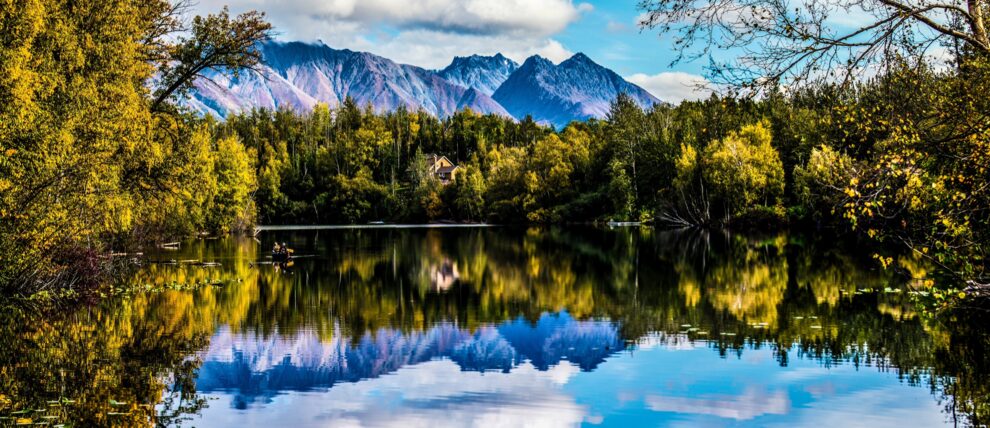
Palmer is located in the center of the lush farmlands of the Matanuska Valley,
42 miles northeast of Anchorage on the Glenn Highway. It lies at approximately
61.599720° North Latitude and -149.11278° West Longitude. (Sec. 04,
T017N, R002E, Seward Meridian.) Palmer is located in the Palmer Recording District.
The area encompasses 3.8 sq. miles of land and 0.0 sq. miles of water. The temperatures
in January range from -36 to 51; in July, 37 to 85. Annual precipitation is
16.5 inches, with 50 inches of snowfall.
History, Culture
and Demographics
Two groups of Athabascans -- the Ahtna and Dena'ina -- have lived in this region
for centuries. George Palmer is said to have arrived in 1875. He was a trader
in Knik, and around 1890, established a trading post on the Matanuska River.
A railway siding was constructed in Palmer in 1916. In 1935, Palmer became the
site of one of the most unusual experiments in American history: the Matanuska
Valley Colony. The Federal Emergency Relief Administration, one of the many
New Deal relief agencies created by President Roosevelt, planned an agricultural
colony in Alaska. 203 families, mostly from Michigan, Wisconsin and Minnesota,
were invited to join the Colony. They arrived in Palmer in the early summer
of 1935. Although the failure rate was high, many of their descendants still
live in the Mat-Su Valley today. The City of Palmer was formed in 1951. Construction
of the statewide road system, and the rapid development of Anchorage, has fueled
growth in the Mat-Su valley. 12.5% of the population are Alaska Native or part
Native. The valley is renowned for the annual Alaska State Fair, where local
farmers produce award-winning vegetables. Popular recreation sites include Hatcher
Pass, Crevasse-Moraine Trails, Kepler Lake, Bonnie Lake, Finger Lake and Long
Lake. During the 2000 U.S. Census, there were 1,555 total housing units, and
83 were vacant. 5 of these vacant housing units are used only seasonally. 1,869
residents were employed. The unemployment rate at that time was 10.84%, although
42.46% of all adults were not in the work force. The median household income
was $45,571, per capita income was $17,203, and 12.66% of residents were living
below the poverty level.
Facilities, Utilities,
Schools and Health Care
Water is provided by three deep wells, is treated and stored in a million-gallon
reservoir. Sewage is collected by pipe and treated in an aerated lagoon facility.
The schools and Palmer Correctional Center operate individual well systems.
All homes are completely plumbed. Matanuska Electric Assoc. is part owner of
the Alaska Electric Generation & Transmission Cooperative, Inc., which operates
a gas turbine plant in Soldotna and also purchases electricity from Chugach
Electric and the Bradley Lake Hydroelectric Project. Piped natural gas, provided
by Enstar, is used to heat homes. The Mat-Su Borough operates the landfill in
Palmer. A sludge disposal site is also available. Electricity is provided by
Matanuska Electric Association. There are 7 schools located in the community,
attended by 2,983 students. Local hospitals or health clinics include Valley
Hospital (352-2860). The Hospital is a qualified Acute Care facility and is
privately-owned. Long Term Care: Palmer Pioneers' Home. Palmer is classified
as a small city, it is found in EMS Region 2C in the Mat-Su Region. Emergency
Services have highway,air, floatplane and helicopter access. Emergency service
is provided by 911 Telephone Service and volunteers. Auxiliary health care is
provided by Palmer Ambulance Service (373-8800/745-4811).
Economy and Transportation
Many residents commute to Anchorage for employment. Palmer's economy is based
on a diversity of retail and other services, City, Borough, State and federal
government. Some light manufacturing occurs. 73 area residents hold commercial
fishing permits. Palmer is home to 200 musk ox whose underwool (qiviut) is knitted
into garments by Alaska Native women from several rural villages. Between 2,500
and 3,500 garments are created each year by these women, and sold by an Anchorage
cooperative. The 75-acre musk ox farm is also a tourist attraction. The University
has an Agricultural and Forestry Experiment Station Office and a district Cooperative
Extension Service office here. The University's Matanuska Research Farm is also
located in Palmer. Palmer
lies on the Glenn Highway. Commercial airlines serve the Anchorage International
Airport, but the Palmer Municipal Airport supports private and chartered services
with two paved airstrips, one at 6,009' long by 60' wide and the other at 3,617'
long by 75' wide. There are seven additional privately-owned airstrips in the
vicinity. Float planes may land at nearby Finger Lake or Wolf Lake. The Alaska
Railroad connects Palmer to Whittier, Seward or Anchorage for ocean freight
delivery.
Source: State of Alaska,
Department of Community and Economic Development.
Palmer Alaska Links
If you would like your website listed here please contact .
More Alaska Cities
Anchorage
Alaska, Barrow,
Bethel, Big
Lake, Butte, Cantwell,
Cooper Landing, Copper
Center, Cordova, Delta
Junction, Denali National Park, Dillingham,
Douglas, Eagle
River Chugiak, Fairbanks Alaska, Girdwood,
Glennallen, Haines,
Healy, Homer,
Hoonah, Iliamna,
Juneau, Kenai,
Kenai Fjords National Park, Ketchikan,
King Salmon, Knik
Fairview, Kodiak, Kotzebue,
Lake Louise, McGrath,
Moose Pass, Nenana,
Nikiski, Nome,
North Pole, Palmer,
Petersburg, Seward
Alaska, Sitka, Skagway,
Soldotna, Sterling,
Talkeetna, Unalaska,
Valdez, Wasilla,
Whittier Alaska, Willow,
Wrangell, Yakutat
[printer version Palmer Alaska]
|