Alaska Tour & Travel ~ www.AlaskaTravel.com
AlaskaTravel.com Home Alaska Travel Destinations Alaska Vacation Packages Alaska Hotels Alaska Day Tours Alaska Transportation Alaska Cruises Reservations

Wrangell Alaska


Population: 2113

Location and Climate
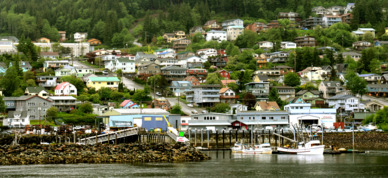
The City of Wrangell is located on the northwest tip of Wrangell Island, 155 miles south of Juneau and 89 miles northwest of Ketchikan. It is near the mouth of the Stikine River, an historic trade route to the Canadian Interior. It lies at approximately 56.470830° North Latitude and -132.37667° West Longitude. (Sec. 25, T062S, R083E, Copper River Meridian.) Wrangell is located in the Wrangell Recording District. The area encompasses 45.3 sq. miles of land and 25.6 sq. miles of water. Wrangell is in the maritime climatic zone and experiences cool summers, mild winters, and year-round rainfall. Summer temperatures typically range from 42 to 64; winter temperatures range from 21 to 44. Average annual precipitation is 82 inches, including 64 inches of snowfall. Fog is common from September through December.

History, Culture and Demographics
Wrangell is one of the oldest non-Native settlements in Alaska. In 1811, the Russians began fur trading with area Tlingits, and built a stockade named Redoubt Saint Dionysius in 1834. The Island was named for Ferdinand Von Wrangel, manager of the Russian-American Co. around 1830. The British of Hudson's Bay Co. leased the fort in 1840, and named the stockade Fort Stikine. A large Stikine Indian village known as Kotzlitzna was located 13 miles south of the fort. The Tlingits claimed their own ancient trade rights to the Stikine River, and protested when the Hudson Bay Company began to use their trade routes. But two epidemics of smallpox, in 1836 and 1840, reduced the Tlingit population by half. The fort was abandoned in 1849 when furs were depleted. The fort remained under the British flag until Alaska's purchase by the U.S. in 1867. In 1868, a U.S. military post called Fort Wrangell was established, named for the Island. The community continued to grow as an outfitter for gold prospectors in 1861, 1874-77, and in 1897. Riotous activity filled gambling halls, dance halls, and the streets. Thousands of miners traveled up the Stikine River into the Cassiar District of British Columbia during 1874, and again to the Klondike in 1897. Glacier Packing Company began operating in Wrangell in 1889. The Wilson & Sylvester Sawmill provided packing boxes for canneries, and lumber for construction. The City was incorporated in 1903. By 1916, fishing and forest products had become the primary industries -- four canneries and a cold storage plant were constructed by the late 1920s. In the 1930s, cold packing of crab and shrimp was occurring. Abundant spruce and hemlock resources have helped to expand the lumber and wood products industry. The Alaska Pulp Corporation sawmill, Wrangell's largest employer, closed in late 1994. A federally recognized tribe is located in the community -- the Wrangell Cooperative Assoc.. 23.8% of the population are Alaska Native or part Native. Wrangell is primarily a non-Native community with a mixture of Tlingit, Russian, British and American historical influences. Logging and fishing have supported the community. During the 2000 U.S. Census, there were 1,092 total housing units, and 185 were vacant. 11 of these vacant housing units are used only seasonally. 1,081 residents were employed. The unemployment rate at that time was 8.48%, although 36.82% of all adults were not in the work force. The median household income was $43,250, per capita income was $21,851, and 8.97% of residents were living below the poverty level.

Facilities, Utilities, Schools and Health Care
Approximately 95% of households are fully plumbed. Two surface reservoirs south of town supply 64 million gallons of water, which is filtered, treated and piped to most households. Sewage receives secondary treatment at the Shoemaker Bay plant. About 20% of residences have individual septic tanks. The City is extending piped water and sewer to Zimovia Highway to eliminate individual systems. The City provides garbage collection service, a recycling facility, and annual hazardous waste disposal events. An incinerator is scheduled to be completed by 1999. Wrangell Municipal Light & Power purchases electricity from the state-owned Tyee Lake Hydro Facility, located 40 miles southeast. The City also owns 7 standby diesel-fueled generators. Funds have been requested to examine the hydroelectric and drinking water potential of Sunrise Lake, on Woronkofski Island. Electricity is provided by Wrangell Municipal Light & Power. There are 3 schools located in the community, attended by 437 students. Local hospitals or health clinics include Wrangell Medical Center (874-7164). The medical center is a qualified Acute Care and Long Term Care facility. Wrangell is classified as a large town/Regional Center, it is found in EMS Region 3A in the Southeast Region. Emergency Services have limited highway, marine, floatplane and airport access. Emergency service is provided by 911 Telephone Service and volunteers. Auxiliary health care is provided by Wrangell Volunteer Fire Dept./Rescue (874-3223).

Economy and Transportation
Wrangell's economy is based on commercial fishing and timber from the Tongass National Forest. Fishing and fish processing are an important segment of the economy. 250 residents hold commercial fishing permits. Dive fisheries are also under development -- 60 divers harvest sea urchins, sea cucumbers and geoducks. Although Wrangell offers a deep-water port, they cater to the smaller cruise ships. Stikine River sportfishing attracts independent travelers. The Alaska Pulp Corp. sawmill was sold to Silver Bay Logging and reopened in April 1998 with 33 employees. The City is accessible by air and water. The State-owned 6,000' long by 150' wide paved lighted runway enables jet service. A seaplane base is adjacent to the runway. Scheduled air taxi services are also available. The marine facilities include a breakwater, deep draft dock, State Ferry terminal, two small boat harbors with 498 slips, and boat launch. Freight arrives by barge, ship, ferry and cargo plane.

Source: State of Alaska, Department of Community and Economic Development.

Wrangell Alaska Links
If you would like your website listed here please contact .

Alaska Waters Inc.
Alaska Waters is Southeast Alaska's premier tour and charter company.
http://www.alaskawaters.com/

More Alaska Cities
Anchorage Alaska , Barrow, Bethel, Big Lake, Butte, Cantwell, Cooper Landing, Copper Center, Cordova, Delta Junction, Denali National Park, Dillingham, Douglas, Eagle River Chugiak, Fairbanks Alaska, Girdwood, Glennallen, Haines, Healy, Homer, Hoonah, Iliamna, Juneau, Kenai, Kenai Fjords National Park, Ketchikan, King Salmon, Knik Fairview, Kodiak, Kotzebue, Lake Louise, McGrath, Moose Pass, Nenana, Nikiski, Nome, North Pole, Palmer, Petersburg, Seward Alaska, Sitka, Skagway, Soldotna, Sterling, Talkeetna, Unalaska, Valdez, Wasilla, Whittier Alaska, Willow, Wrangell, Yakutat

spacer
spacer

Featured Items

spacer
spacer
spacer
spacer